先选一条使用路线Choose your workflow
这份教程对应手机扫码枪 iOS 1.0(构建 1),适用于 iPhone 与 iPad。第一次使用按“安装 → 设置 → 本地扫码或 Wi-Fi 连接 → 历史 → 导出”完成;只想保存在手机上,可以跳过电脑端。This guide covers Scan Input for iOS 1.0 (build 1) on iPhone and iPad. Start with installation → settings → local scanning or Wi-Fi → history → export. Skip the desktop setup if you only need records on your phone.
| 用途Goal | 选择Mode | 准备条件Requirements |
|---|---|---|
| 手机识别与保存Recognize and save locally | 本地扫码,无需连接电脑Local scanning, no computer connection | iOS 17 及以上;真机相机权限,或选择含码照片iOS 17+; camera permission on a real device, or a selected photo containing a code |
| 将中文、英文或商品编号录入电脑Enter Chinese, English or product identifiers on a computer | Wi-Fi 连接Wi-Fi connection | 电脑运行手机扫码枪桌面端,双方处于可互通的局域网Run Scan Input Desktop on the computer; both devices must be reachable on the local network |
| 不安装电脑端的蓝牙键盘输出Bluetooth keyboard output without a desktop app | 当前 iOS 版不提供蓝牙 HIDThe current iOS app has no Bluetooth HID | iOS 使用 Wi-Fi;Android 与鸿蒙的 HID 操作见各自教程Use Wi-Fi on iOS; see the Android and HarmonyOS guides for their HID workflows |
本页截图来自 iPhone 17 Pro 模拟器、iOS 26.5、手机扫码枪 1.0 中文界面,可点击查看原图。已实测模拟器的照片选择器、设置、手动 Wi-Fi 成功连接与直接断开,以及演示记录的搜索、删除/清空确认后取消、格式选择和 CSV 系统保存;当前照片识别返回“识别失败:Could not create inference context”,没有验证识别成功。历史、搜索、删除与导出截图使用专为教程准备的演示记录,不是模拟器扫码生成。相机与照片识别成功、多码选择步骤按当前版本功能核对,需在真机执行验收。模拟器也没有本 App 可用的相机设备,因此相机拍摄、闪光灯和声音震动需在真机核对。相机不可用页是模拟器限制,并不表示用户拒绝了授权。设备名称、地址、端口和系统按钮以你的实际界面为准。Screenshots use an iPhone 17 Pro simulator running iOS 26.5 and Scan Input 1.0 in Chinese. Click an image to view it full size. The simulator photo picker, settings, successful manual Wi-Fi connection/disconnection, demo-record search, cancelling deletion/clear confirmations, format selection and CSV system saving were verified. Photo recognition currently fails with Could not create inference context; successful recognition was not verified. History, search, deletion and export screenshots use tutorial demo records, not records scanned by the simulator. Camera/photo recognition and multi-code selection steps reflect the current app flow and require a real-device check. The simulator has no camera device usable by this app, so live capture, flashlight, sound and vibration also require a real device. Its camera-unavailable screen does not mean permission was denied. Use your own device name, address, port and system labels.
下载状态、首次启动与权限Download status, first launch and permissions
从官网确认 iOS 官方安装入口Check the official iOS installation entry
打开官网软件下载,找到 iOS 卡片。当前 iOS 版显示“即将上线”,尚未提供 App Store 下载链接;本教程展示开发版本的使用流程,不代表商店已经上架。正式开放后,通过该卡片的官方 App Store 链接获取,核对应用名称“手机扫码枪 / Scan Input”,完成安装后打开。Open the official download section and find iOS. It currently says Coming soon and has no App Store download link. This guide demonstrates the development version and does not mean the store release is available. After release, follow the card’s official App Store link, check the name Scan Input, install and open the app.
阅读协议并完成首次欢迎提示Read the agreements and complete first-launch prompts
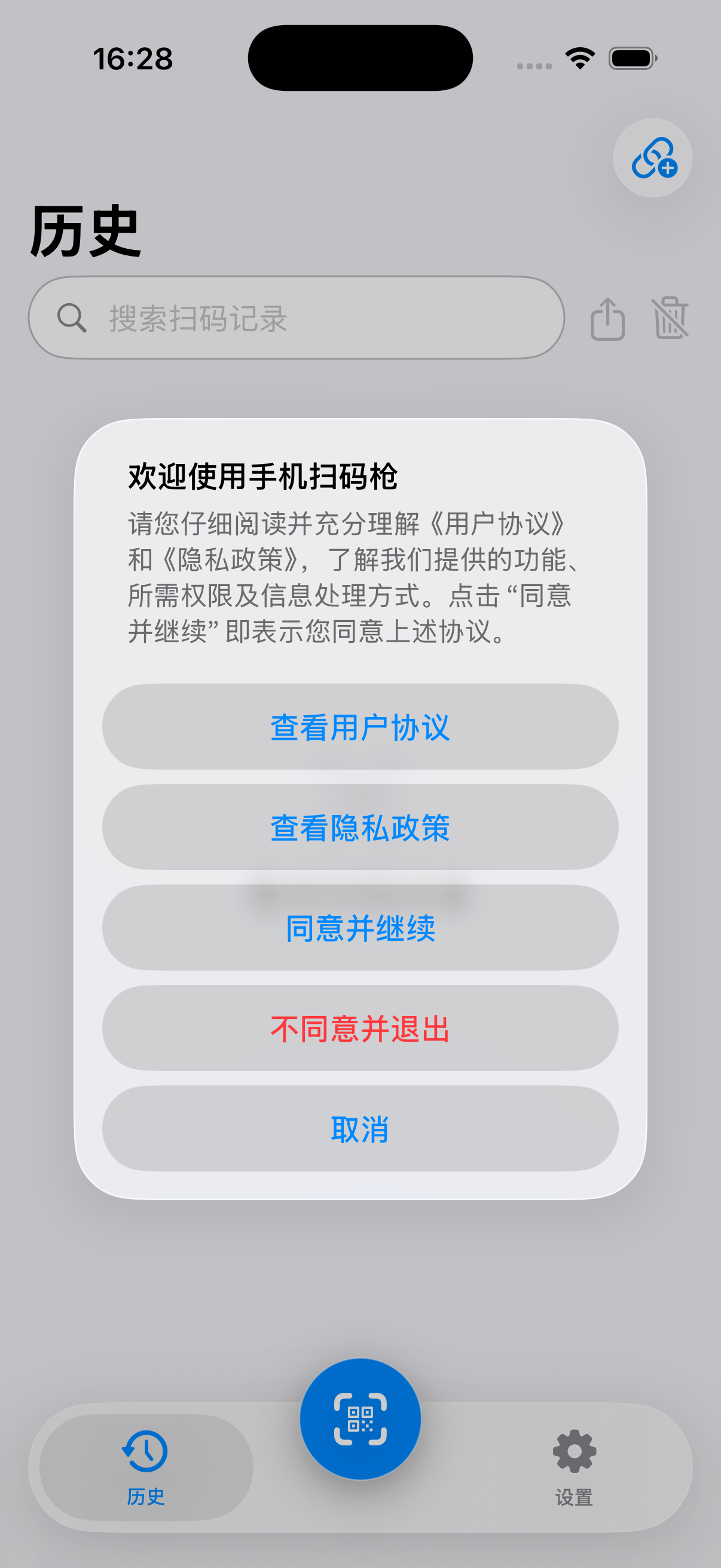
首次打开可点“查看用户协议”或“查看隐私政策”;阅读并决定接受后点“同意并继续”。未接受时会继续出现欢迎提示,不能进入正常使用流程。随后“开始使用手机扫码枪”提示可选择“查看使用教程”或“稍后查看”。协议也能从“设置”随时再次查看。两份文档均为与官网 iOS 版本一致的 App 内置文本,无需联网;阅读页可滚动查看全文,点击“完成”返回。On first launch, use View User Agreement and View Privacy Policy. If you decide to accept, tap Agree and continue. Without acceptance, the welcome prompt returns and normal use remains unavailable. The next Get started prompt offers View user guide or Later. You can reopen both documents in Settings. Both are bundled in the App and match the website’s iOS versions, so reading requires no network connection. Scroll through the full text and tap Done to return.
按功能允许相机和本地网络Allow camera and local-network access as needed
点击底部中央扫码按钮;未连接电脑时可选“继续扫码”,或选“立即连接”先设置 Wi-Fi。真机首次请求相机权限时点“允许”。连接局域网电脑时,如出现本地网络访问提示也需允许。相册识别使用系统选图器,只需选择一张图片;不用为了选图授予整个图库访问权。Tap the round Scan button at the bottom center. If disconnected, choose Continue scanning, or Connect now to set up Wi-Fi first. On a real device, allow the first camera prompt. Also allow local-network access if prompted when connecting to the desktop. Scan photo uses the system picker to select one image; full-library access is not needed for this selection.
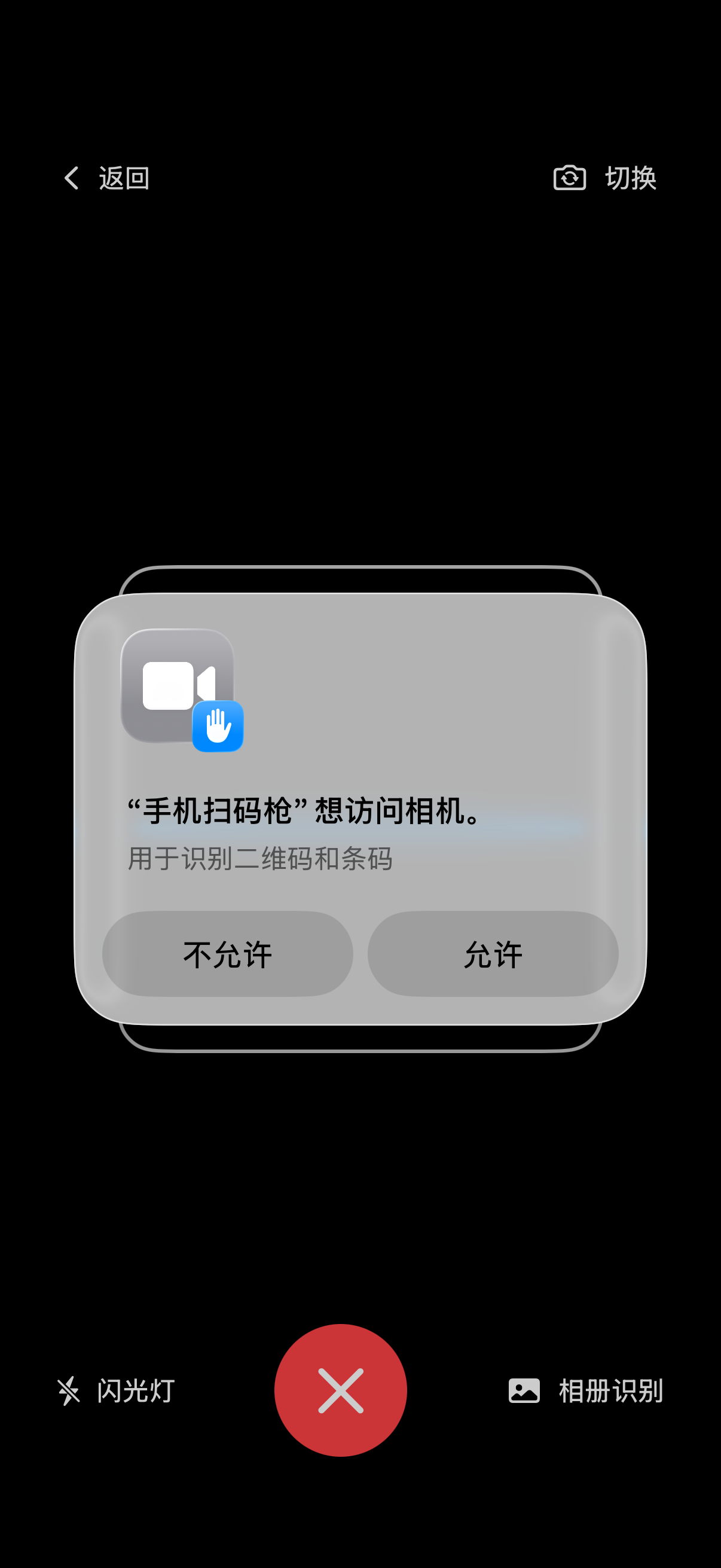
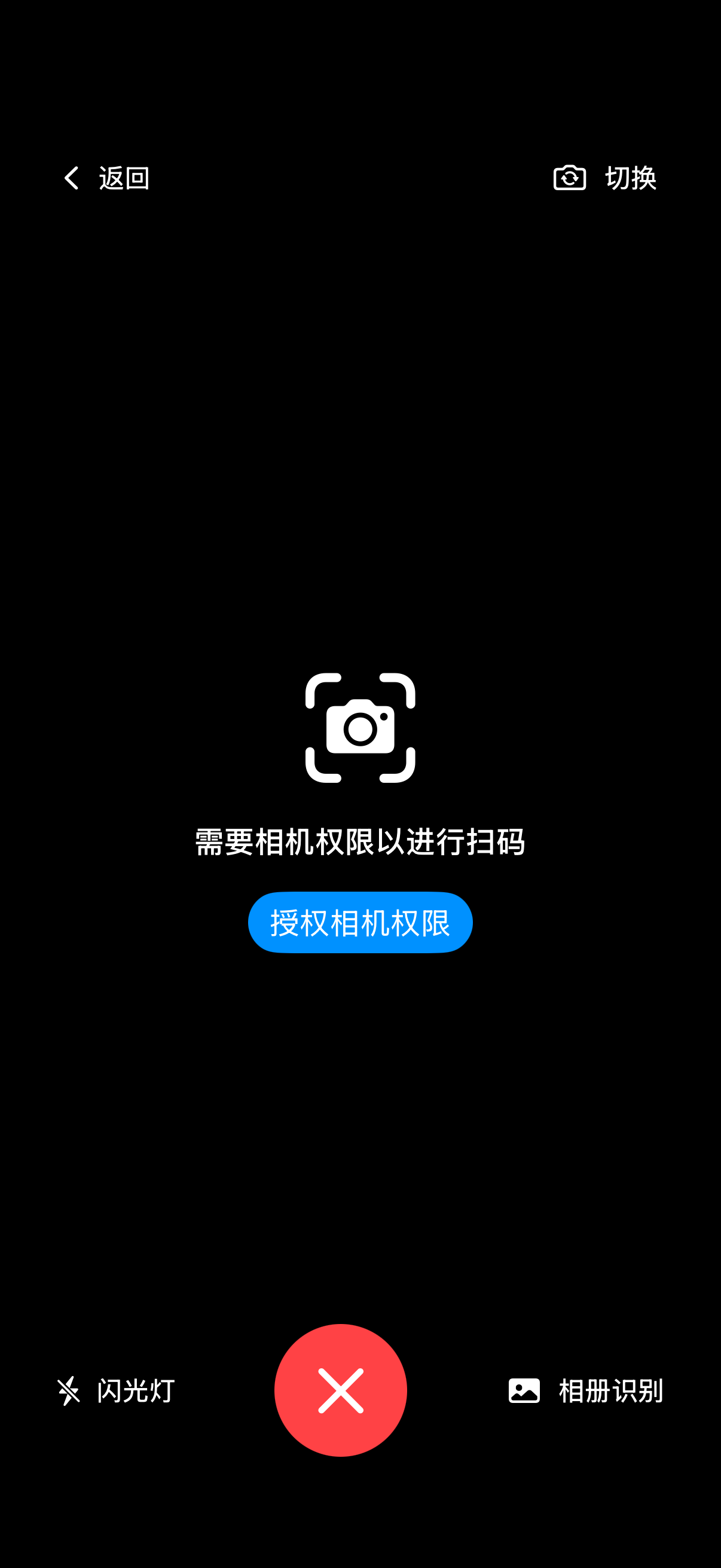
真机显示“需要相机权限以进行扫码”时,点“授权相机权限”打开 iOS 设置,允许相机后返回 App 再次进入扫码页。本地网络被拒绝时,在系统“设置 → App → 手机扫码枪”或该系统对应的应用设置中开启本地网络;旧版 iOS 可能直接在“设置”列表找到应用。模拟器没有摄像头时,即使允许相机也无法打开真机预览;仍可打开“相册识别”选图,但本页模拟器的照片识别另有运行环境错误,见相册章节。On a real device, Camera access is required to scan offers Allow camera access, which opens iOS Settings. Enable Camera, return and reopen the scanner. If Local Network was denied, enable it under system Settings → Apps → Scan Input or the equivalent app settings; older iOS versions may list the app directly in Settings. A simulator without a camera cannot show a real preview even after permission is allowed. Scan photo can still open the picker, but this simulator has a separate photo-recognition runtime error described in the photo chapter.
主界面底部能看到“历史”“设置”和中央扫码按钮;“设置”显示版本;真机能打开相机预览并识别已知条码图片。模拟器这里只核对菜单、设置与选图入口,识别结果需要在真机继续检查。无需注册账号。Check History, Settings and the central Scan button, plus the version in Settings. Verify a camera preview and known-code recognition on a real device. Here the simulator checks menus, settings and the photo-picker entry; complete recognition checks on a real device. No account registration is required.
认识主界面与未连接提醒Find the main controls and offline reminder
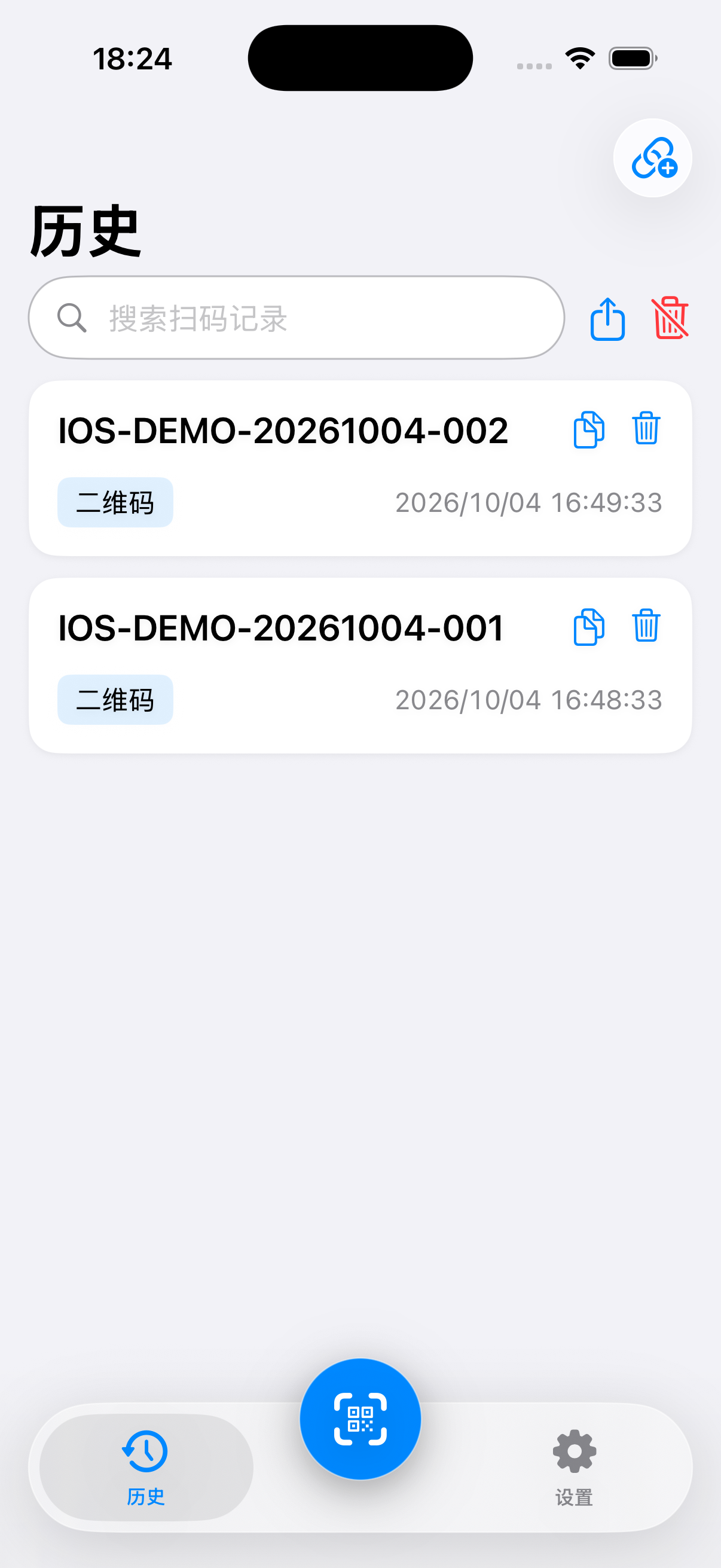
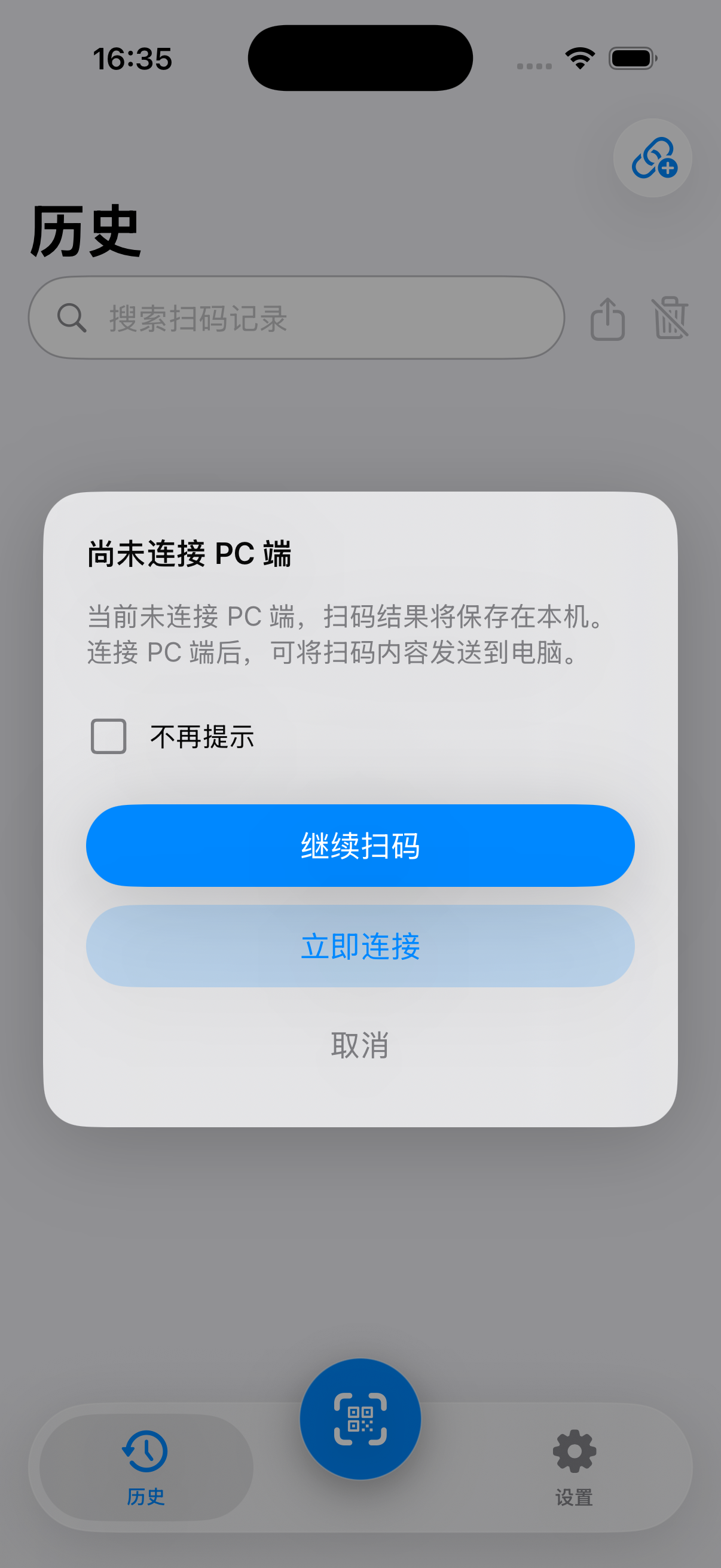
- “历史”:最新记录在前。搜索筛选显示;导出时可选全部或搜索结果。向上滚动后,导出与清空收进搜索框内的“更多”菜单。History shows newest records first. Search filters the list; export can include all records or the search results. After scrolling up, export and clear move into the More menu within search.
- 右上连接状态图标:未连接时显示链环加号图标,点它打开 Wi-Fi 连接表单。连接中显示进度;已连接时为闭合链环,点击会直接断开。The top-right connection status icon shows a link with a plus badge when disconnected; tap it to open the Wi-Fi form. Progress appears while connecting, and a closed link appears when connected. Tapping the connected link disconnects immediately.
- 中央“扫码”:进入扫码页。未连接时出现“尚未连接 PC 端”,选“继续扫码”只保存本机,选“立即连接”打开 Wi-Fi;“取消”回到主界面。勾选“不再提示”后再选继续或连接,可关闭后续提醒。Scan opens the scanner. When disconnected, a reminder offers Continue scanning for local records, Connect now for Wi-Fi, or Cancel to return. Check Don’t remind me again before continuing or connecting to suppress later reminders.
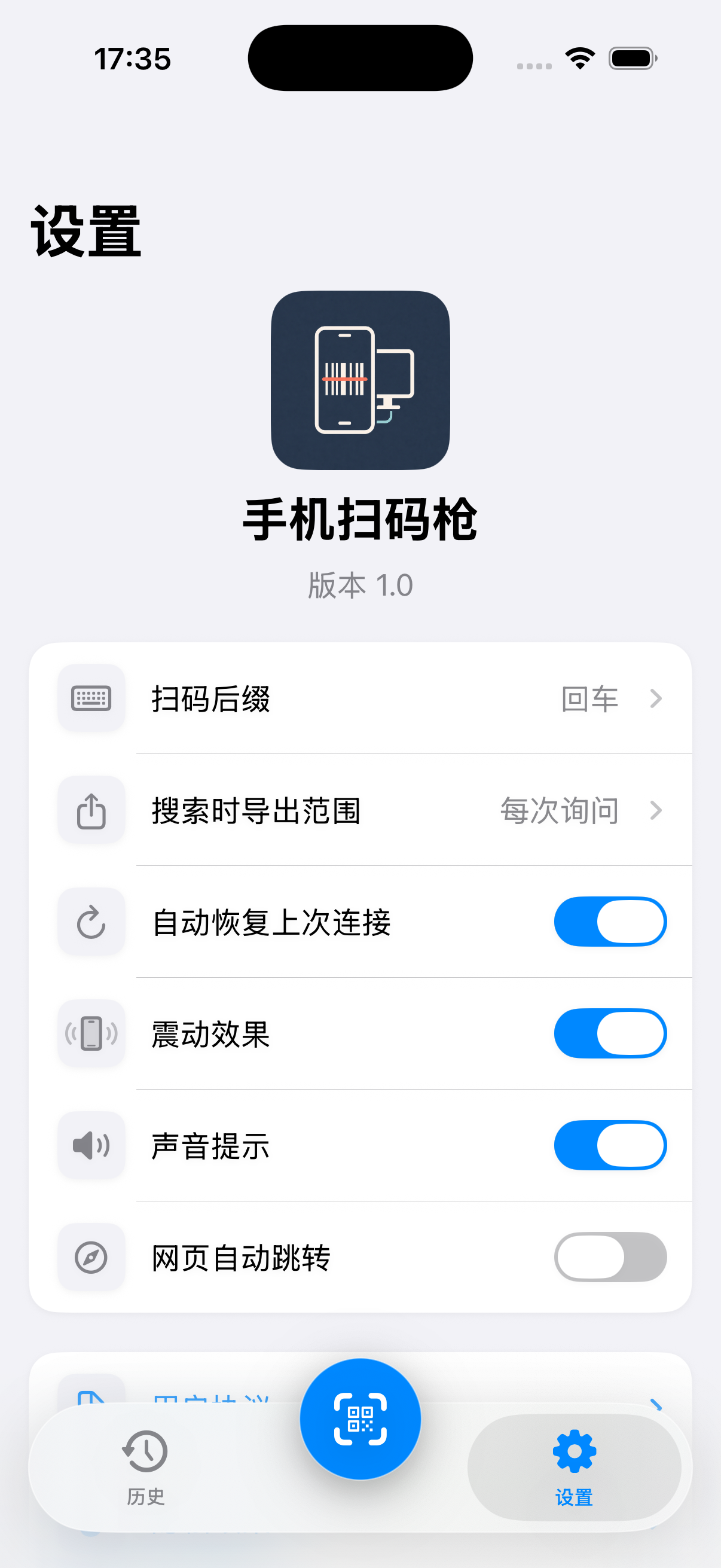
- “设置”:后缀、自恢复、声音、震动、网页跳转;下方还有协议、隐私政策、官网、教程、电脑端下载和开发者入口。Settings provides suffix, restore, sound, vibration and webpage opening, plus legal documents, website, guide, desktop download and developer links.
未连接也能保存普通扫码结果。最新结果、手机提示音或震动只确认识别;有连接时还会尝试发送。是否完整录入电脑,需要核对目标输入框里的真实文字和光标。手机复制只复制到 iOS 剪贴板,App 没有内建电脑剪贴板同步。Normal scan results save even without a connection. A latest result, sound or vibration confirms recognition; an active connection also attempts sending. Check the actual text and cursor in the computer target field to verify entry. Copy places text on the iOS clipboard; the app has no built-in desktop clipboard synchronization.
设置后缀、反馈与连接恢复Set the suffix, feedback and connection restore
选择扫码后缀Choose the scan suffix
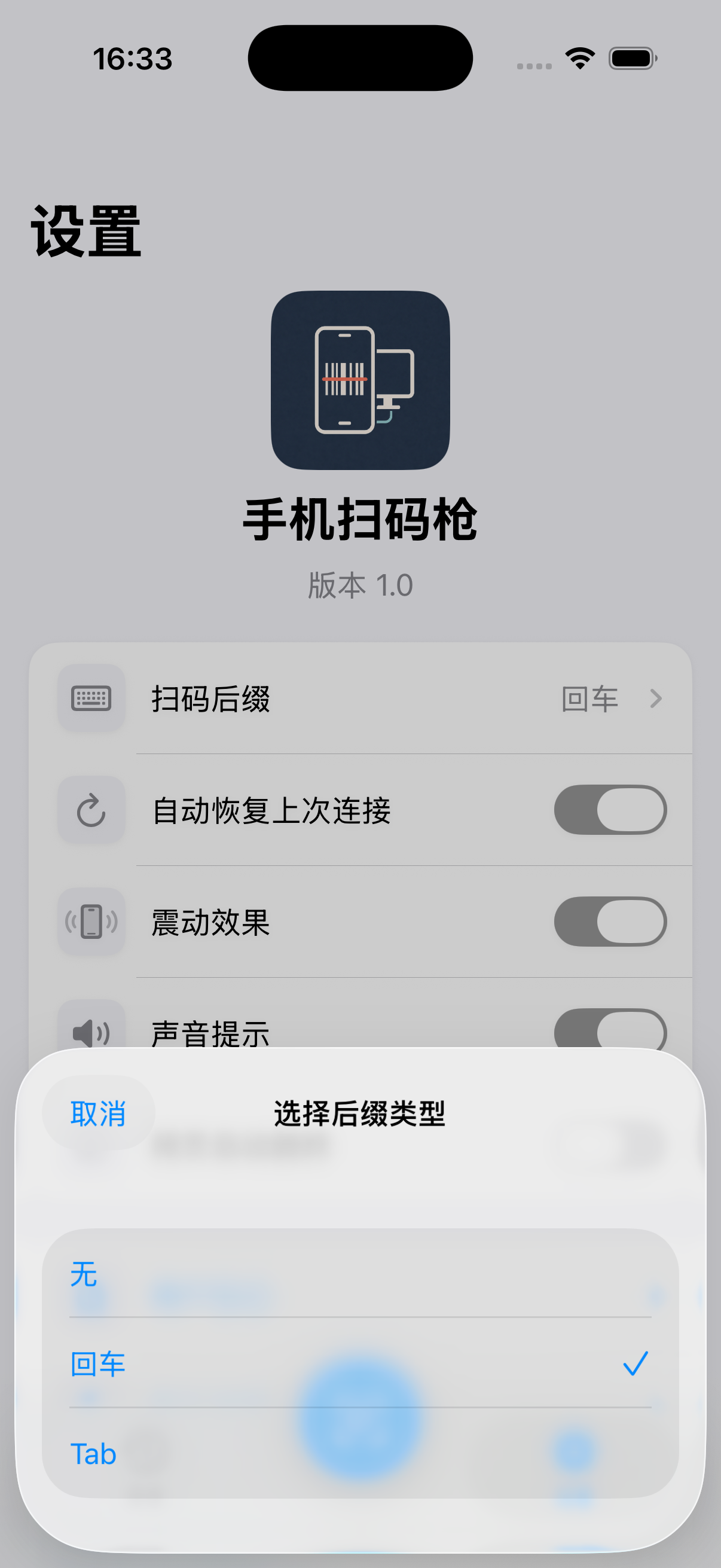
点底部“设置 → 扫码后缀”,在“选择后缀类型”中选择“无”“回车”或“Tab”;选择后返回设置。默认是回车。无适合保留光标位置,回车适合逐行录入,Tab 适合在支持 Tab 导航的表格或表单跳到下一格。后缀只附加到发往电脑的内容,手机历史、复制和导出保留原文。Open Settings → Scan suffix and choose None, Enter or Tab in Select suffix. Selection returns to Settings; Enter is the default. None keeps the cursor in place, Enter suits line-by-line entry, and Tab moves through cells or form fields that support Tab navigation. The suffix is added only to computer output; history, copy and exports retain the original text.
调整提示与网页自动跳转Adjust feedback and automatic link opening
“震动效果”“声音提示”默认开启,可按场景关闭;模拟器不会播放本 App 的扫码提示音或震动。“网页自动跳转”默认关闭,开启后普通 HTTP/HTTPS 网址会调用系统浏览器,同时保存记录。需要持续盘点时可保持关闭,避免识别网址后切出扫码页。Vibration and Sound are on by default and can be disabled. The simulator does not play this app’s scan sound or vibration. Open web links automatically is off by default. If enabled, normal HTTP/HTTPS addresses open in the system browser while the record is saved. Keep it off during continuous inventory to avoid leaving the scanner.
确认自恢复的范围并找到帮助入口Check restore behavior and locate help
“自动恢复上次连接”默认开启。App 启动和返回前台时,若尚未连接且未在连接中,会尝试上次成功的 Wi-Fi 地址与端口;电脑和原网络仍需可用。手动断开后再回前台也可能重连,不希望如此时关闭该选项。不要将自恢复理解为锁屏或后台始终在线。设置下方可打开官网、使用教程、PC 端下载、用户协议与隐私政策。Restore last connection is on by default. At launch and on foreground return, the app attempts the last successful Wi-Fi address and port if it is neither connected nor connecting. The computer and network must still be available. Returning to the foreground after a manual disconnect may reconnect; turn restore off if undesired. It does not guarantee continuous background or locked-screen connectivity. The lower Settings section opens the website, guide, desktop download and legal documents.
iOS 的电脑连接方式:使用 Wi-FiComputer connection on iOS: use Wi-Fi
当前 iOS 版没有“蓝牙 HID 连接”、附近设备列表或蓝牙键盘输出入口。系统蓝牙配对不能替代 App 的 Wi-Fi 连接,也无需按 Android/鸿蒙教程去发布 HID 服务或移除配对。The current iOS app has no Bluetooth HID connection, nearby-device list or Bluetooth keyboard-output entry. System Bluetooth pairing does not replace its Wi-Fi connection. Android/HarmonyOS HID-service or re-pairing steps do not apply here.
需要把扫码内容录入电脑,继续阅读本页的 Wi-Fi 连接步骤,安装电脑端并允许必要的输入权限。只想在手机保存与导出时,直接进入 扫码 或 相册识别。To enter scan text on a computer, follow the Wi-Fi steps, install the desktop app and allow its input permissions. For phone-only records and export, go directly to scanning or photo recognition.
本页仅描述 iOS。Android 与鸿蒙可提供蓝牙 HID,并各自有不同的配对、权限和字符处理流程;需要这些平台的操作时,请切换到Android 教程或鸿蒙教程。This page describes iOS. Android and HarmonyOS offer Bluetooth HID with their own pairing, permission and character-handling behavior. Use the Android guide or HarmonyOS guide for those platforms.
Wi-Fi:安装电脑端并连接Wi-Fi: install and connect the desktop app
完整安装对应电脑端Install the matching desktop package
打开官网下载区,按电脑系统与 CPU 架构选择手机扫码枪桌面端。macOS 将 App 拖入应用程序;Windows 完整解压 ZIP 后运行;Linux 保留并运行整个 AppDir 或包内 AppImage。已安装时直接打开电脑端的连接服务页。Choose Scan Input Desktop for your computer OS and CPU from the official downloads. On macOS, copy the app to Applications; on Windows, extract the full ZIP; on Linux, keep the full AppDir or use the bundled AppImage. If already installed, open its connection-service page.
macOS:选择芯片,拖入应用程序macOS: choose your chip and copy to Applications
- 在 Apple 菜单 →“关于本机”确认 Apple 芯片或 Intel,下载对应 DMG;桌面端要求 macOS 13 及以上。Check Apple menu → About This Mac for Apple silicon or Intel and download the matching DMG. The desktop client requires macOS 13+.
- 打开 DMG,将
Scan Input Desktop.app拖入“Applications / 应用程序”,从应用程序文件夹启动。Open the DMG, dragScan Input Desktop.appinto Applications and launch it there. - 如系统阻止打开,核对官方来源与名称后按“隐私与安全性”的系统提示处理。打字权限见下方。If the system blocks opening, check the official source and name, then follow its Privacy & Security prompt. Typing permission is described below.
Windows:解压完整 ZIPWindows: extract the full ZIP
- 将
ScanInput-windows-x64.zip解压到固定文件夹,保留所有随包 DLL、插件、数据库驱动和 legal 等目录。ExtractScanInput-windows-x64.zipto a stable folder and keep all bundled DLLs, plugins, database drivers and legal folders. - 运行解压目录中的
DroidCodeScannerPC.exe;不要从 ZIP 预览启动或只移动一个 EXE。RunDroidCodeScannerPC.exefrom the extracted folder; do not launch from ZIP preview or move only the EXE. - 启动失败时,可运行包内
diagnose_release.bat(若有),将具体错误交给技术支持。If launch fails, usediagnose_release.batif included and report its exact error to support.
Linux:启动 AppDir 或包内 AppImageLinux: launch AppDir or a bundled AppImage
- 解压
ScanInput-linux-x86_64.tar.gz,阅读RUN_GUIDE.txt(若有)。ExtractScanInput-linux-x86_64.tar.gzand readRUN_GUIDE.txtif present. - AppDir 包进入
DroidCodeScannerPC.AppDir/usr/bin并运行./DroidCodeScannerPC,保留整个 AppDir。缺运行库时按具体错误与发行版包管理器处理。For AppDir, enterDroidCodeScannerPC.AppDir/usr/binand run./DroidCodeScannerPC. Keep the entire AppDir; resolve missing runtime libraries using the error and your distribution package manager. - 若包内提供 AppImage,在文件属性中允许执行后启动。自动打字还需输入工具,见下面的系统配置。If the package includes an AppImage, allow execution in file properties and launch it. Automatic typing also requires the tools described below.
准备可互通局域网与电脑连接服务Prepare a reachable network and the desktop service
让 iPhone/iPad 与电脑处于可以相互访问的局域网:手机通常连 Wi-Fi,电脑可连同一局域网的 Wi-Fi 或网线。电脑端打开“连接服务”,确认服务启动,核对当前 IP 地址、监听端口和连接二维码。不要填写路由器或手机的 IP。默认端口是 9876;电脑改过端口时使用它实际显示的数字。Place the iPhone/iPad and computer on a reachable local network. The phone normally uses Wi-Fi; the computer may use Wi-Fi or Ethernet on that network. Open Connection service on the desktop, start the service and check its current IP, listening port and connection QR. Do not use the router or phone address. The default port is 9876; use the actual displayed value if changed.
在手机手动填写 IP 和端口Enter the IP and port on the phone
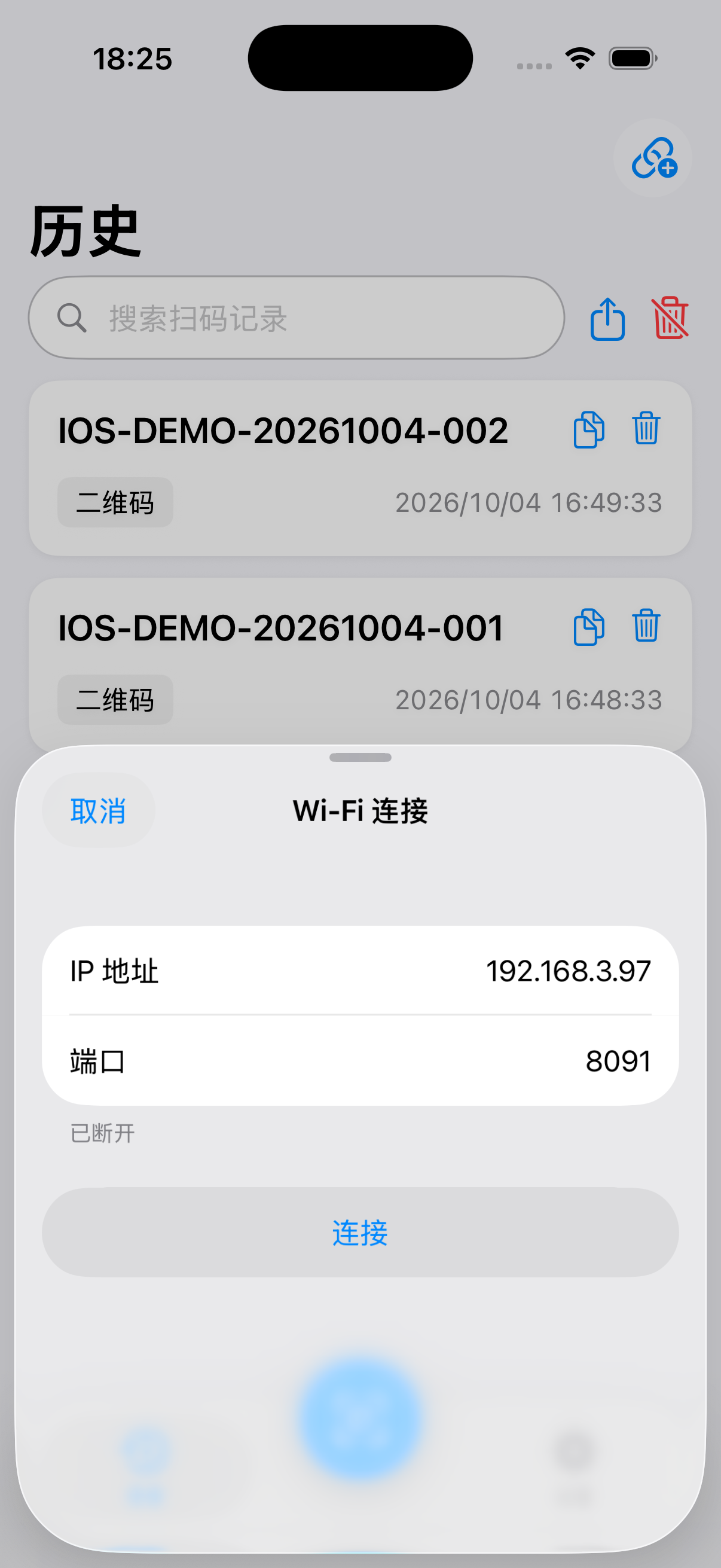
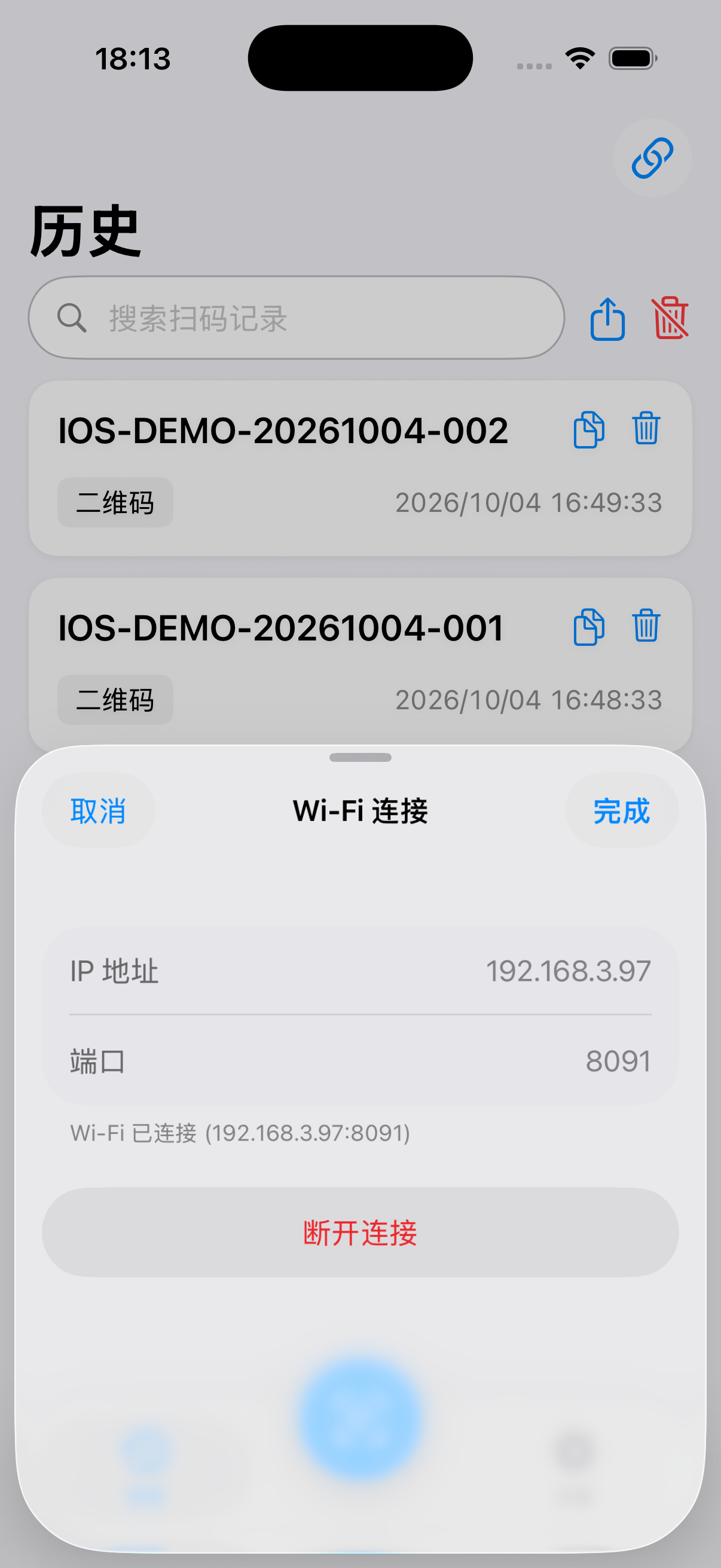
在“历史”点右上连接状态图标,打开“Wi-Fi 连接”。将电脑端显示的地址填入“IP 地址”,端口填入“端口”,点“连接”;若键盘挡住按钮,可先将窗口上拉。点击后键盘自动收起,地址与端口始终采用左侧标题、右侧输入框的布局。未连接时输入框为黑字、浅色背景,可以编辑;连接过程中显示进度,输入框变为灰字、灰色背景并禁用,连接按钮也禁用,防止重复发起。成功后输入框继续保持灰色禁用状态,显示“Wi-Fi 已连接(IP:端口)”;下方只显示水平居中的“断开连接”按钮,右上“完成”关闭窗口并返回主界面。In History, tap the top-right connection status icon to open Wi-Fi connection. Enter the desktop address in IP address and its port in Port, then tap Connect. Expand the sheet if the keyboard covers the button. Tapping Connect automatically dismisses the keyboard. The address and port always use labels on the left and text fields on the right. When disconnected, the editable fields have black text and a light background. While connecting, progress appears, the fields have gray text and gray backgrounds and are disabled, and Connect is disabled to prevent another attempt. On success, the fields remain gray and disabled and Wi-Fi connected (IP:port) appears. Below them, only a horizontally centered Disconnect button appears; Done at the top right closes the sheet and returns to History.
也可扫描电脑连接二维码并确认Alternatively scan the desktop QR and confirm
真机打开扫码页对准电脑连接二维码;也可从“相册识别”选择该连接码截图。检测到 dcs://connect?ip=…&port=… 后,App 弹出“扫码连接”,显示目标 IP 与端口。核对后选“连接”,或选“不连接”取消。扫码页不会自动关闭;等待后返回“历史”检查闭合链环,再测试输出。连接二维码不会进入手机扫码历史,也不会作为商品文本发送。On a real device, scan the desktop connection QR, or select its screenshot through Scan photo. A detected dcs://connect?ip=…&port=… code opens Connect from scan with the destination IP and port. Check them and choose Connect, or Don’t connect to cancel. The scanner stays open; wait, return to History, check the closed link and test output. A connection QR is not saved as an ordinary scan record or sent as product text.
出现本地网络授权时允许访问。若连接失败,确认电脑服务仍在运行、IP 和端口正确、防火墙允许应用在当前局域网通信。访客 Wi-Fi、AP 隔离、VPN 或多网卡可能影响互通;相同 Wi-Fi 名称不等于设备一定可达。关闭连接窗口只关闭界面,不是断开连接或取消已发起的连接。Allow local-network access when prompted. For failure, check the running desktop service, correct IP/port and firewall permission for the local network. Guest Wi-Fi, access-point isolation, VPNs and multiple adapters may interfere; matching Wi-Fi names do not prove reachability. Dismissing the connection sheet closes the interface; it does not disconnect or cancel an already-started connection.
配置电脑输入权限并验收一条已知码Configure desktop input permissions and verify known text
在电脑打开普通文本编辑器或表格,将光标放到目标输入位置,再扫描或从相册识别一条已知内容。先看电脑端是否收到记录,再核对目标输入框中完整文字、中文、前导零和后缀产生的换行/跳格。电脑收到记录而目标框为空时,检查焦点和下面的系统输入配置;提示音或手机历史不代表电脑已输入。Focus a plain text editor or spreadsheet cell on the computer, then scan or recognize a known value. First check desktop receipt, then verify the actual text, Unicode, leading zeros and suffix-driven line/cell movement. If the desktop receives a record but the field is empty, check focus and the system input configuration below. Phone sound or history does not prove typing.
| 电脑系统Computer | 自动输入设置Typing setup |
|---|---|
| macOSmacOS | 在“系统设置 → 隐私与安全性 → 辅助功能”允许正在运行的 Scan Input Desktop,必要时退出并重启,再测试普通编辑器。Allow the running Scan Input Desktop under System Settings → Privacy & Security → Accessibility. Restart if needed and test a plain editor. |
| WindowsWindows | 无需额外打字工具。先测试普通权限的目标应用;管理员权限目标可能阻止普通权限桌面端输入。参见 SendInput 文档。No extra typing tool is required. Test a normally running target first; an elevated target may block input from the normal desktop process. See SendInput documentation. |
| LinuxLinux | 优先使用 ydotool,需可在桌面进程 PATH 找到并访问正常运行的 ydotoold / socket;服务需有 /dev/uinput 权限。仅 ydotool 无法启动时才尝试适用于 X11 的 xdotool;普通 Wayland 应用应使用配置好的 ydotool。The client tries ydotool first; it must be on the desktop process PATH and reach a working ydotoold/socket with /dev/uinput permission. Only a failure to start ydotool triggers xdotool, suitable for X11. Use configured ydotool for normal Wayland apps. |
Linux 输入工具配置参考 ydotool 官方说明 与 xdotool 官方说明。ydotool 启动后返回错误时当前版本不会自动回退 xdotool,需检查服务、socket 和权限;正式录入前分别测试中文、空格、回车和 Tab。See the official ydotool and xdotool instructions. If ydotool starts but returns an error, this version does not automatically fall back to xdotool. Check service, socket and permissions, and test Chinese, spaces, Enter and Tab before real entry.
断开、换电脑并核对自动恢复Disconnect, change computers and check restore
在已连接的“历史”页点右上闭合链环,会立即断开,没有二次确认。再点连接状态图标打开连接表单,填写新的目标。也可在已连接的表单内点居中的“断开连接”;断开后地址和端口恢复编辑,下方恢复“连接”按钮,可填写新目标再连接。关闭表单不会断开。电脑换网络或端口后重新核对地址;若“自动恢复上次连接”开着,App 下次启动或返回前台可能再次连接已保存目标。In connected History, tap the closed link to disconnect immediately without a second confirmation. Tap the connection status icon again to open the form and enter a new destination. You can also tap the centered Disconnect button in the connected sheet. After disconnecting, the address and port become editable and Connect returns, so you can enter a new target. Dismissing the sheet does not disconnect. Recheck addresses after network/port changes. If Restore last connection is enabled, a later launch or foreground return may reconnect to the saved target.
真机相机扫码与连续录入Camera scanning and continuous entry on a real device
打开扫码页,让一个码完整进入画面Open the scanner and place one whole code in view
点底部中央扫码按钮,未连接提示中按需要选“继续扫码”或“立即连接”。真机默认后置相机,将条码或二维码完整放入画面,保留周围空白,调整距离、光线与反光。右上“切换”可切前后相机;后置相机支持时可用左下“闪光灯”,前置模式该按钮禁用。Tap the central Scan button and choose Continue scanning or Connect now if reminded. On a real device, the rear camera is the default. Keep the whole barcode or QR code and its border visible; adjust distance, light and glare. Switch at the top right changes front/rear cameras. Flashlight at the bottom left works when supported on the rear camera and is disabled on the front camera.
核对最新结果,移开条码再扫下一条Check the latest result and move the code away
普通内容识别后显示“最新扫码结果”,写入手机历史,有连接时同时尝试发送。可点结果卡片的复制图标;App 停留在扫码页继续识别。扫完移开上一条码:相机对同一码约 1.5 秒内抑制重复,长期留在画面里仍可能再次保存和输入。左上“返回”或底部红色关闭按钮结束扫码。Normal content appears under Latest scan result and saves to phone history; an active connection also attempts sending. Use the result card’s copy icon if needed. The scanner stays open for the next code. Move the previous code out of view: the camera suppresses same-code repeats for about 1.5 seconds, but a stationary code may be recorded and typed again later. Use Back or the red close button to exit.
出现“扫码成功,但发送失败,请检查连接”时,内容已经识别并写入手机历史。先恢复电脑连接,再重新扫描已知内容或复制原文手动录入;当前历史没有重发按钮。先检查目标已有内容,避免重复提交。If Scan succeeded, but sending failed appears, the recognized content has already been saved to phone history. Restore the connection, then rescan known content or copy it for manual entry; History has no resend control. Check any existing target text first to avoid duplicate submission.
真机同一画面有多个码时When a real camera frame contains multiple codes
等待画面冻结并确认候选Wait for the frozen frame and candidates
相机同时识别到多个码时会冻结当前画面,显示“检测到多个码,请点击需要的识别框”,在各码位置画出编号框。当前最多提供 8 个候选;超过时调整范围分组识别。看到多个框并不表示所有码已经保存。When the camera detects multiple codes, it freezes the current frame and shows Multiple codes detected. Tap the code you want, with numbered boxes on the codes. Up to eight candidates are offered; scan larger groups in smaller batches. Multiple boxes do not mean all codes have been saved.
只点需要的一个框,或重新扫描Select one needed code, or scan again
点击目标编号框,只处理该码,随后约 0.8 秒恢复扫描。若选错画面,点“重新扫描”放弃本帧,重新对准。要录入多个商品,选择一个后继续下一轮;当前没有“全部处理”按钮。核对历史新增的内容与电脑目标,确认没有录入未选中的码。Tap the target box to process only that code; scanning resumes after about 0.8 seconds. If the frame is wrong, Scan again discards it so you can re-aim. For several products, select one and continue with another frame. There is no Process all button. Check the new history entry and desktop target to verify that unselected codes were not entered.
多码识别框需要在真机上完成点选。本页使用的模拟器没有可用相机,其相机不可用状态也会遮住多码识别框,因此这里仅说明真机操作。本页模拟器只演示照片选择器,未验证照片识别成功。Complete multi-code box selection on a real device. The simulator used here has no usable camera, and its camera-unavailable state also hides multi-code boxes, so this chapter describes the real-device procedure. This simulator demonstrates photo selection, without successful photo recognition.
从相册或截图识别Recognize a photo or screenshot
从扫码页选择一张含码图片Select one code image from the scanner
在扫码页右下点“相册识别”,打开 iOS 系统照片选择器,找到含条码或二维码的原图或截图,点选一张。一次选择一张;取消则不识别。图片可来自业务截图或自己保存的条码图,尽量使用清晰完整的原图。Tap Scan photo at the bottom right to open the iOS photo picker. Find an original image or screenshot containing a barcode or QR code and select one image. One image is selected at a time; cancellation performs no recognition. Use a clear, complete image of your own code or business screenshot.
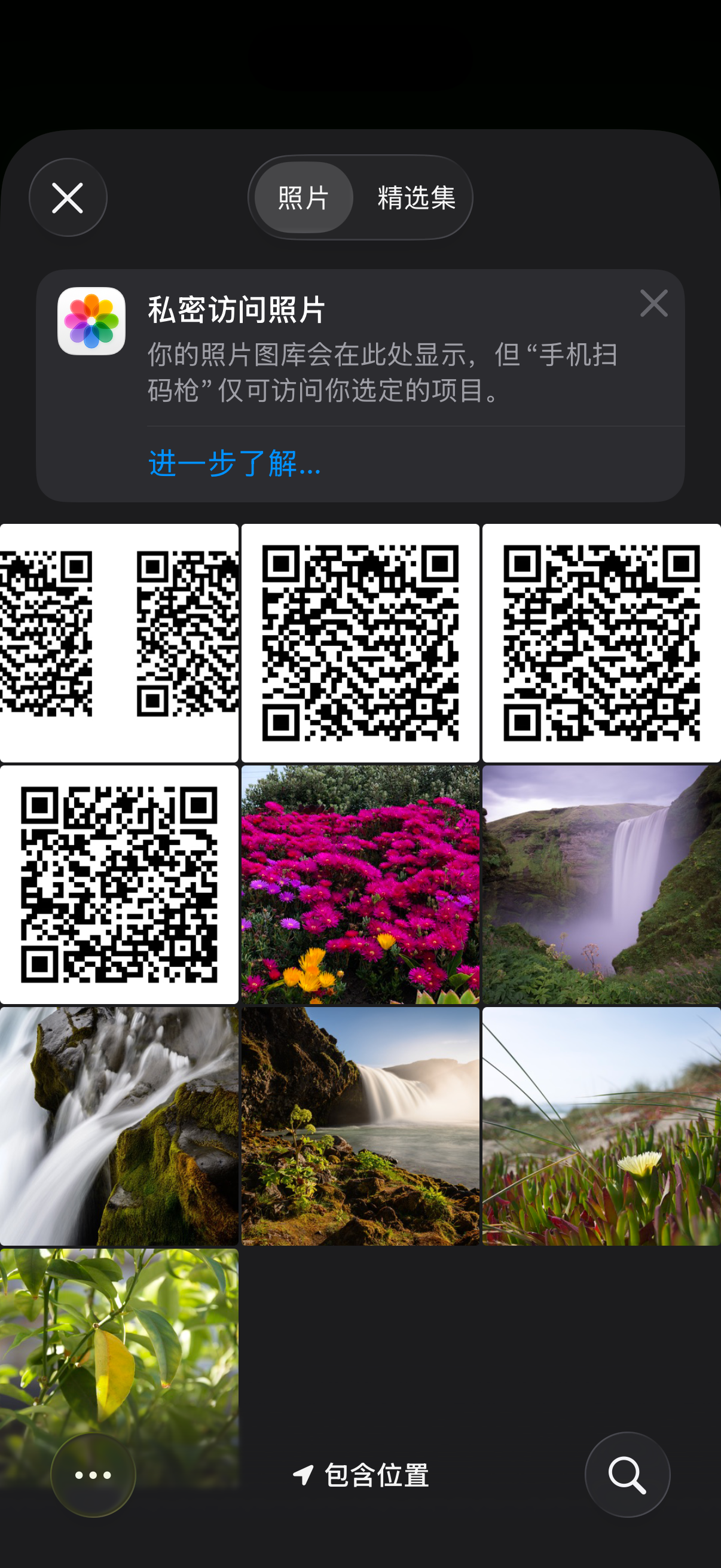
本页使用的 iOS 26.5 模拟器在照片识别时返回“识别失败:Could not create inference context”。因此本页不展示相册识别成功图,也不将演示历史当作扫码成功记录。下列单码、多码和连接码流程按当前 App 功能说明,识别成功与实际发送需在真机验证。Photo recognition in the iOS 26.5 simulator used here failed with Could not create inference context. This page therefore has no successful photo-recognition screenshot and does not present demo history as scanned records. The single-code, multi-code and connection-code procedures below describe the current app; verify recognition and actual sending on a real device.
按单码、多码与连接码检查结果Check single-code, multi-code and connection-code results
真机识别成功时,单个普通码显示最新结果、保存历史,有连接时发送。真机上多码照片也冻结并显示编号框,需要单选一个;不会像 Android 相册那样一次处理全部。选择连接二维码时按 Wi-Fi 章节确认连接,连接码不入历史。识别失败提示“无法解码图片”“未识别到二维码”或“识别失败”;其中“未识别到二维码”表示这张图没有识别结果,也适用于条码。After successful recognition on a real device, a single normal code shows its latest result, saves history and sends if connected. On a real device, a multi-code photo also freezes with numbered boxes and requires one selection; it does not process all results like Android gallery recognition. For a connection QR, confirm it as described in Wi-Fi; it does not enter History. Failure messages include Unable to decode the image, no recognized code, or Recognition failed. The Chinese no-QR message also covers an image with no recognized barcode.
换用原图或更清晰截图,保留码边缘,避免过小、严重压缩和裁切;真机可改用相机。本页 iOS 26.5 模拟器实测选图后出现“识别失败:Could not create inference context”,不是条码内容无效的证明;请在真机检查照片识别。无相机状态还可能遮住多码识别框,多码选择也需在真机完成。识别成功后先看原文,再确认电脑实际输入;不要只凭最新一条判断多次操作全部完成。Try an original or clearer image with the code edges intact; avoid tiny, heavily compressed or cropped codes. On a real device, try the camera. Photo recognition in this iOS 26.5 simulator failed with Could not create inference context; that does not prove the code itself is invalid. Check photo recognition on a real device. The no-camera state can also hide multi-code boxes, so complete multi-code selection on a real device. After recognition, check the original text and actual desktop input rather than assuming every operation succeeded from the latest result alone.
搜索、复制与删除历史Search, copy and delete history
本章及导出章节的记录为教程专用的演示数据,用于说明搜索、复制、删除与保存位置,不声称由模拟器识别生成。你在真机上使用时,应先扫码建立自己的记录,再核对内容、时间和导出数量。The records in this chapter and Export are tutorial demo data used to explain search, copy, deletion and save destinations. They were not generated by simulator recognition. On a real device, scan to create your own records, then check their text, timestamps and exported count.
搜索内容或码的格式Search content or code type
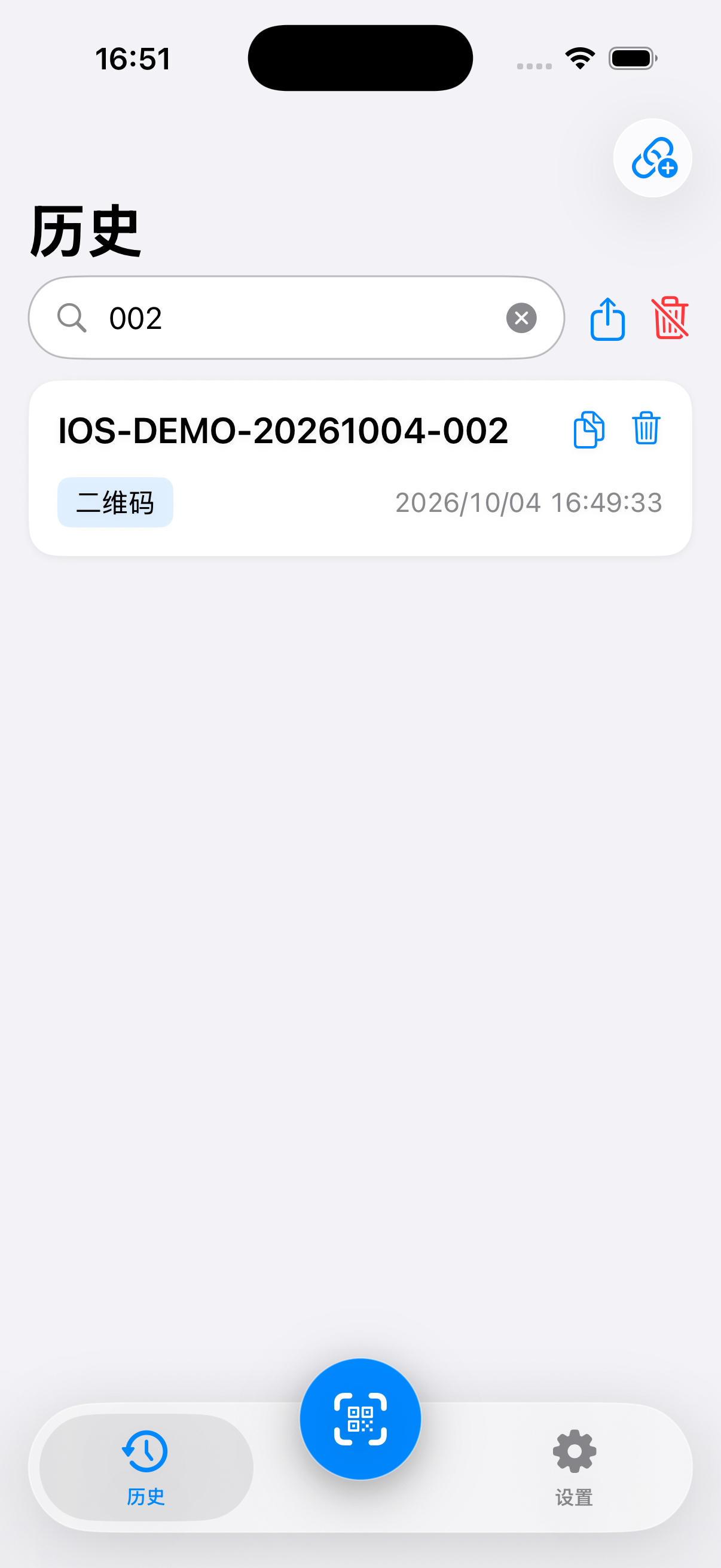
点底部“历史”,记录按最新时间在前显示,卡片含原文、格式与时间。点“搜索扫码记录”,输入部分内容或“二维码”“条码”等格式文字;搜索不区分大小写,可匹配格式,不按日期筛选。点搜索框的清除按钮恢复全部显示。搜索时可以选择本次导出范围,也可记住选择。Open History to see newest records first with original text, type and timestamp. Enter part of the content or a localized type such as QR code or Barcode in Search scan records. Search is case-insensitive and matches content/type rather than date. Use the search clear button to show everything again. During a search, choose the export scope and optionally remember it.
复制需要的一条原文Copy one record’s original text
在对应卡片点复制图标,看到“已复制”后到目标 App 粘贴;卡片正文也支持系统文字选择。复制的是原始扫码文字,不含回车/Tab 发送后缀。卡片最多显示三行,没有独立详情或重发按钮;长内容可复制到文本编辑器核对。手机剪贴板不会由本 App 自动发送到电脑。Tap the record’s copy icon, wait for Copied, then paste in the target app. The card text also supports system text selection. Copy retains the original value without the sending suffix. Cards show up to three lines and have no separate detail/resend button; paste long content into a text editor to inspect it. The app does not automatically transmit the iOS clipboard to the computer.
区分单条删除和清空全部Distinguish one-record deletion from clearing all
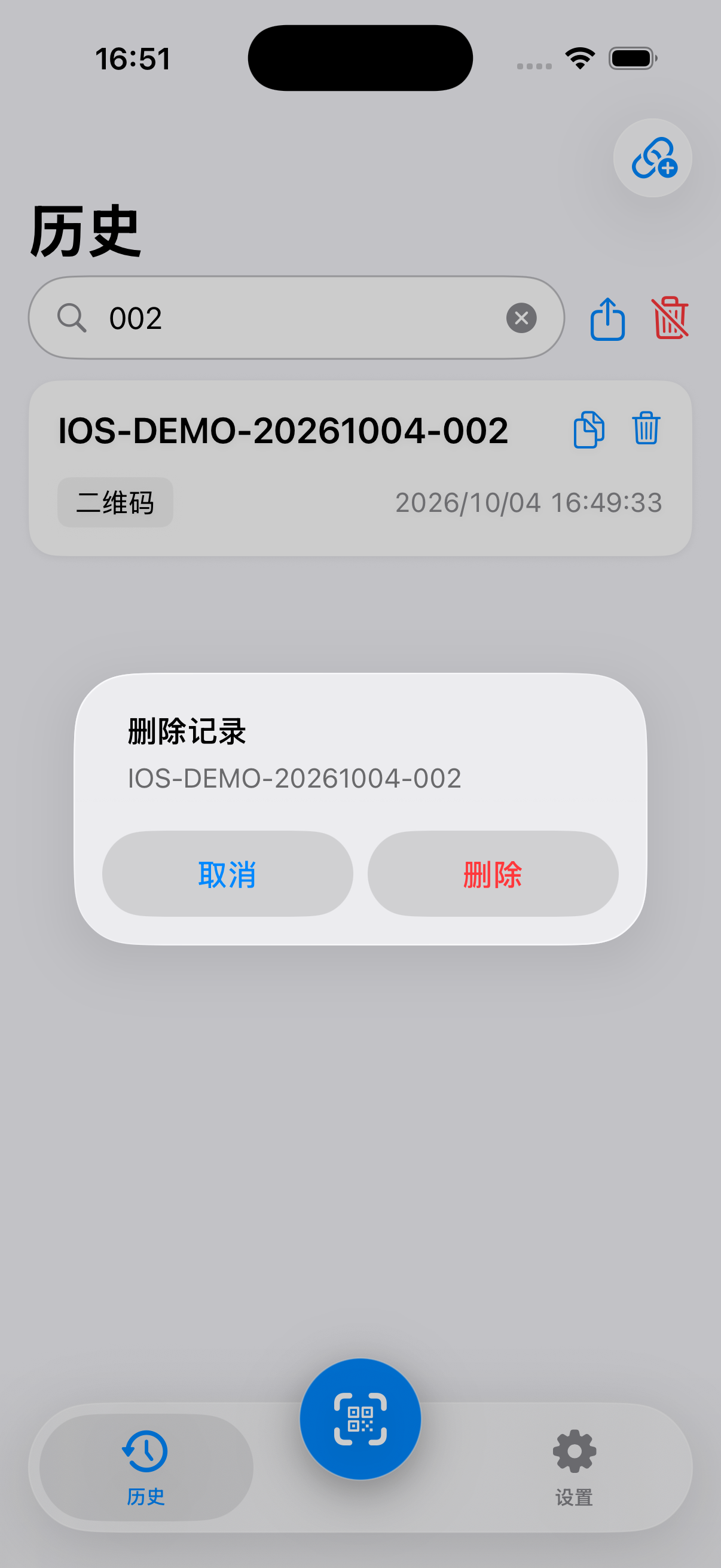
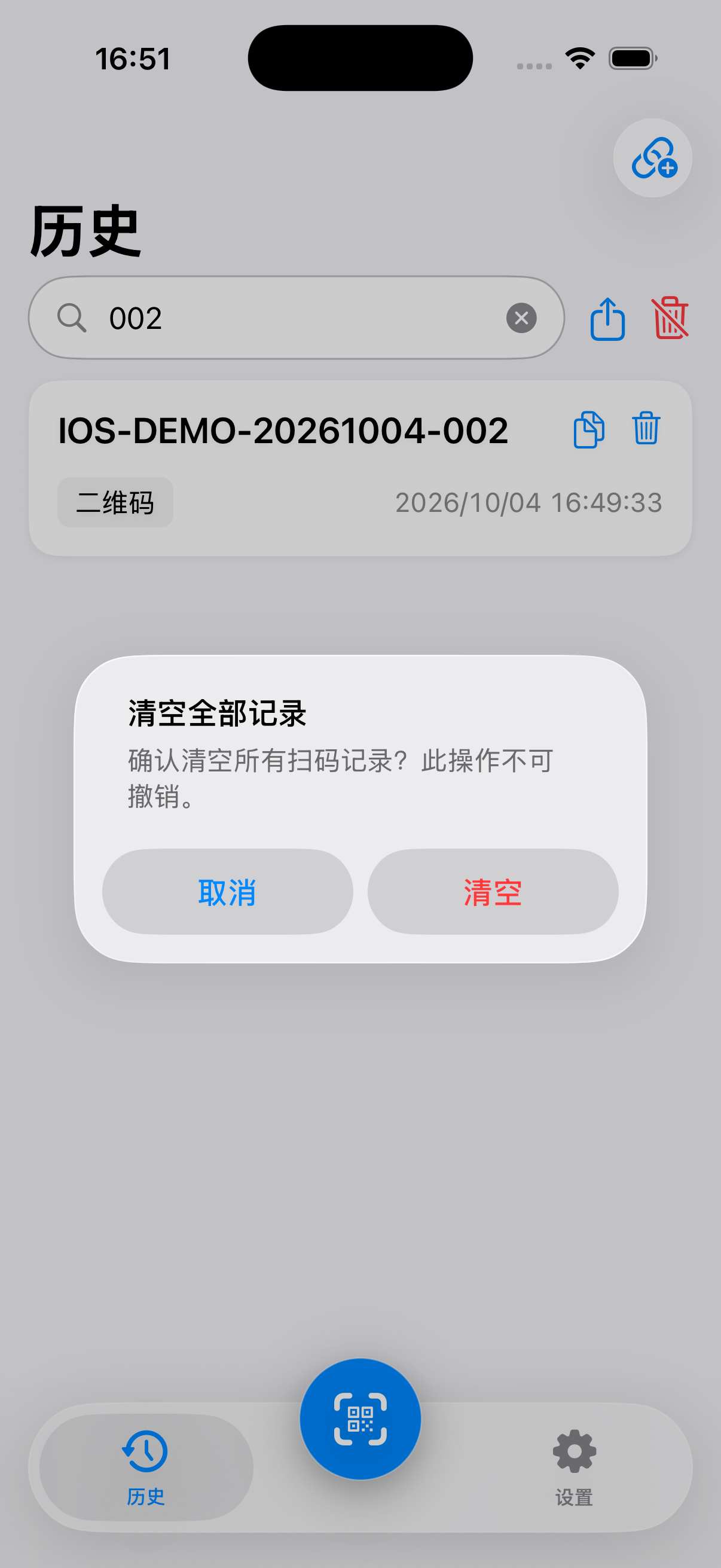
卡片上的垃圾桶只针对该条,弹出“删除记录”并显示内容;核对后点“删除”,或“取消”。搜索旁带斜线垃圾桶是“清空全部记录”,滚动后可从“更多”找到;确认“清空”会删除全部历史,即使当前有搜索条件。删除和清空不可撤销,需要留档先导出。The trash icon on a card targets that record and opens Delete record with its content. Check it and choose Delete or Cancel. The crossed-trash action beside search, or in More after scrolling, is Clear all records. Confirming Clear removes all history even with a search active. Deletion cannot be undone; export first if needed.
导出 CSV 或 Excel,并选择范围Export CSV or an Excel-readable table and choose the scope
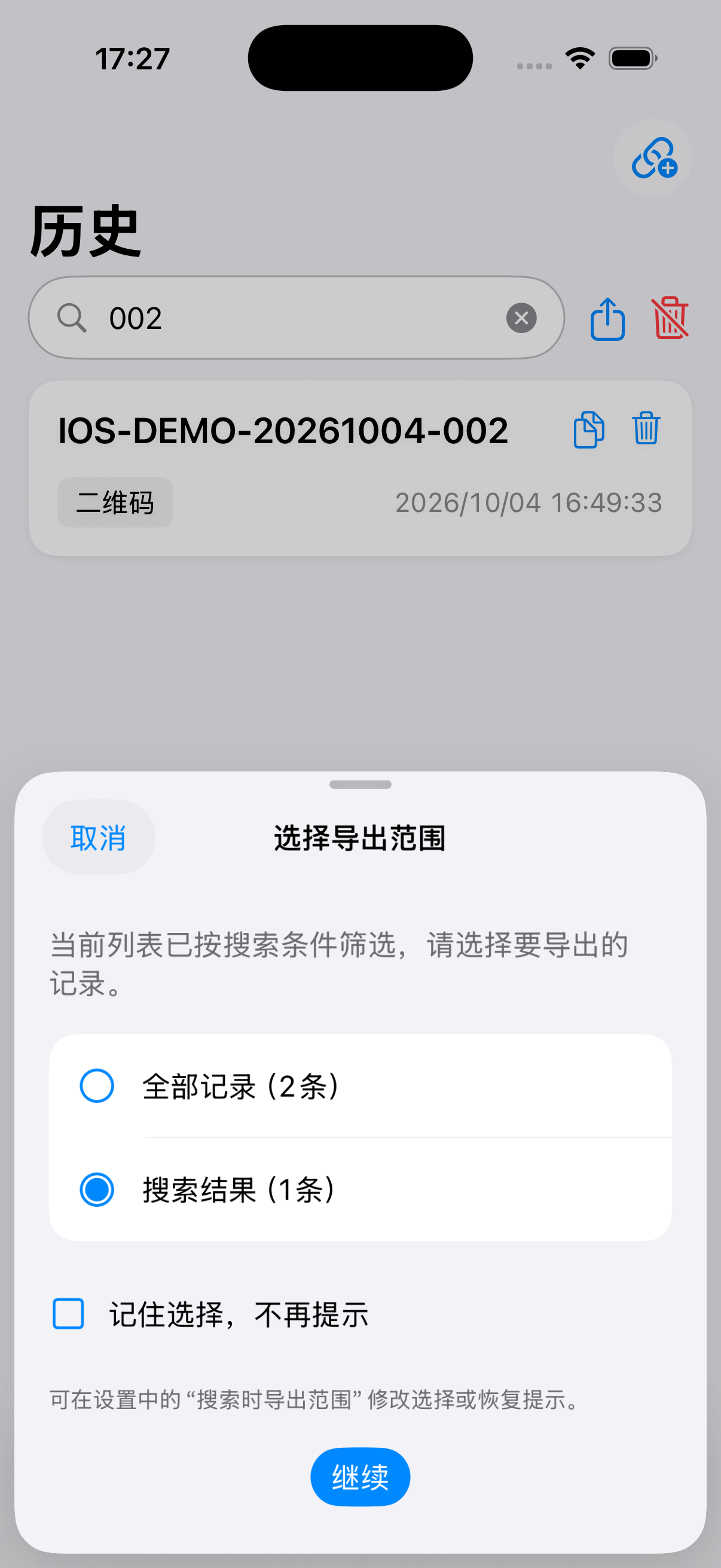
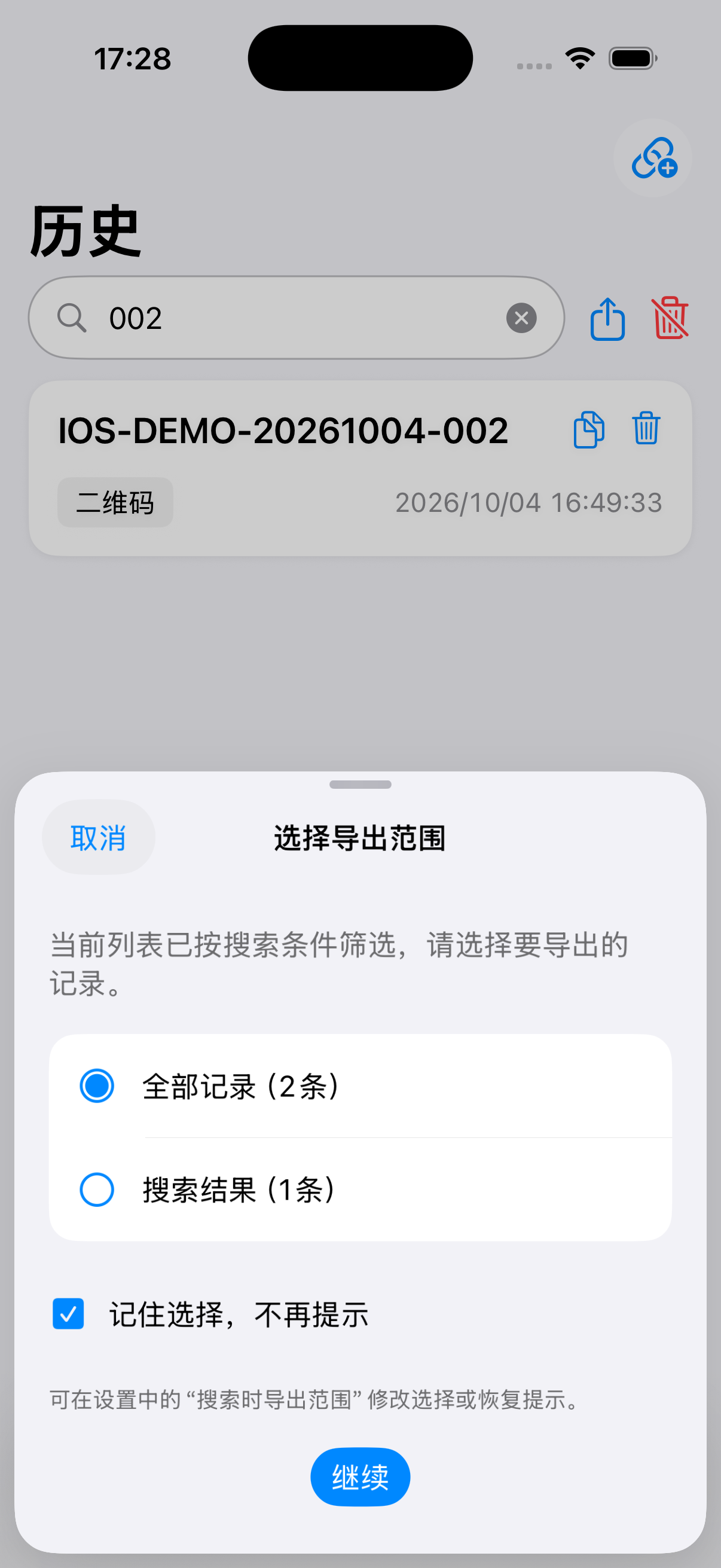
勾选“记住选择,不再提示”并点“继续”,以后搜索时会直接按所选范围进入格式选择;取消范围对话框不会导出,也不会保存本次选择。记住的范围只作用于搜索中的列表,无搜索时仍导出全部。需要修改或恢复提示时,到“设置 → 搜索时导出范围”选择“每次询问”“全部记录”或“搜索结果”。已记住“搜索结果”但本次无匹配时会提示无法导出,不会改为全部记录。Check Remember my choice and don’t ask again and tap Continue to use that scope directly during future searches. Cancelling the scope dialog neither exports nor saves the choice. A remembered scope applies only while searching; without a filter, all history is exported. Use Settings → Export scope while searching to choose Ask every time, All records or Search results. A remembered Search results scope with no matches reports that nothing can be exported instead of switching to all records.
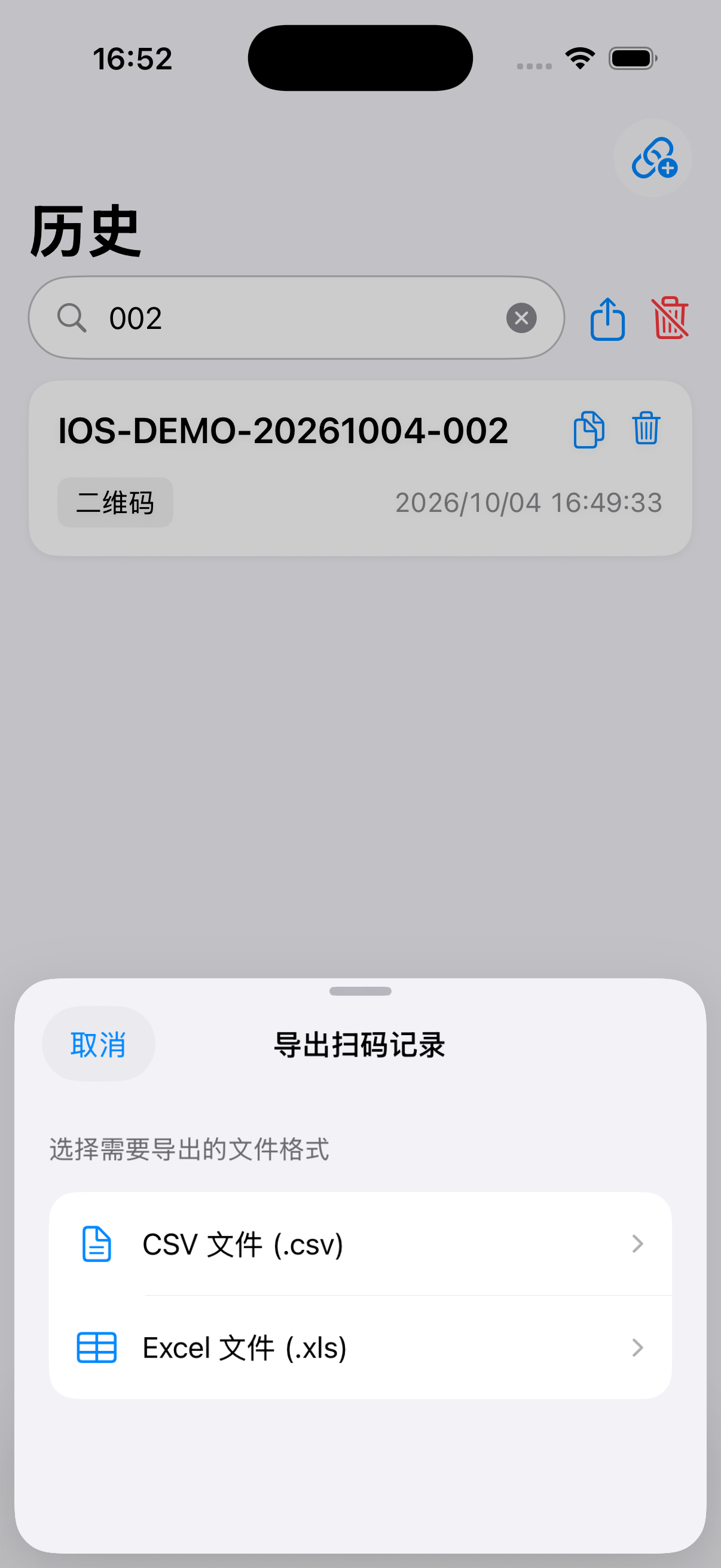
没有搜索条件时直接选择 CSV 或 Excel,导出全部历史。有搜索条件时,先在“选择导出范围”中选择“全部记录”或“搜索结果”,核对记录数,再点“继续”选择格式。导出包含所选范围内的所有记录,不限于屏幕上可见的几条;CSV 与 Excel 使用相同范围。Without a search filter, choose CSV or Excel to export all history. With a filter, use Choose export scope to select All records or Search results, check the counts, then tap Continue to choose a format. Every record in the chosen scope is included, including rows outside the screen. CSV and Excel use the same scope.
点导出并选择格式Tap export and choose a format
点历史页的导出图标(入口收起时从“更多”打开)。搜索中先确认导出范围,再选择“CSV 文件 (.csv)”或“Excel 文件 (.xls)”。没有任何历史时无法导出;搜索无匹配时仍可明确选择“全部记录”,不会生成空的搜索结果文件。Tap the export icon in History, or open it from More if collapsed. During a search, confirm the export scope before choosing CSV file (.csv) or Excel file (.xls). Empty history cannot be exported. With no search matches, you can explicitly choose All records; no empty search-results file is created.
在分享表选择“保存到文件”并保存Choose Save to Files and complete the save
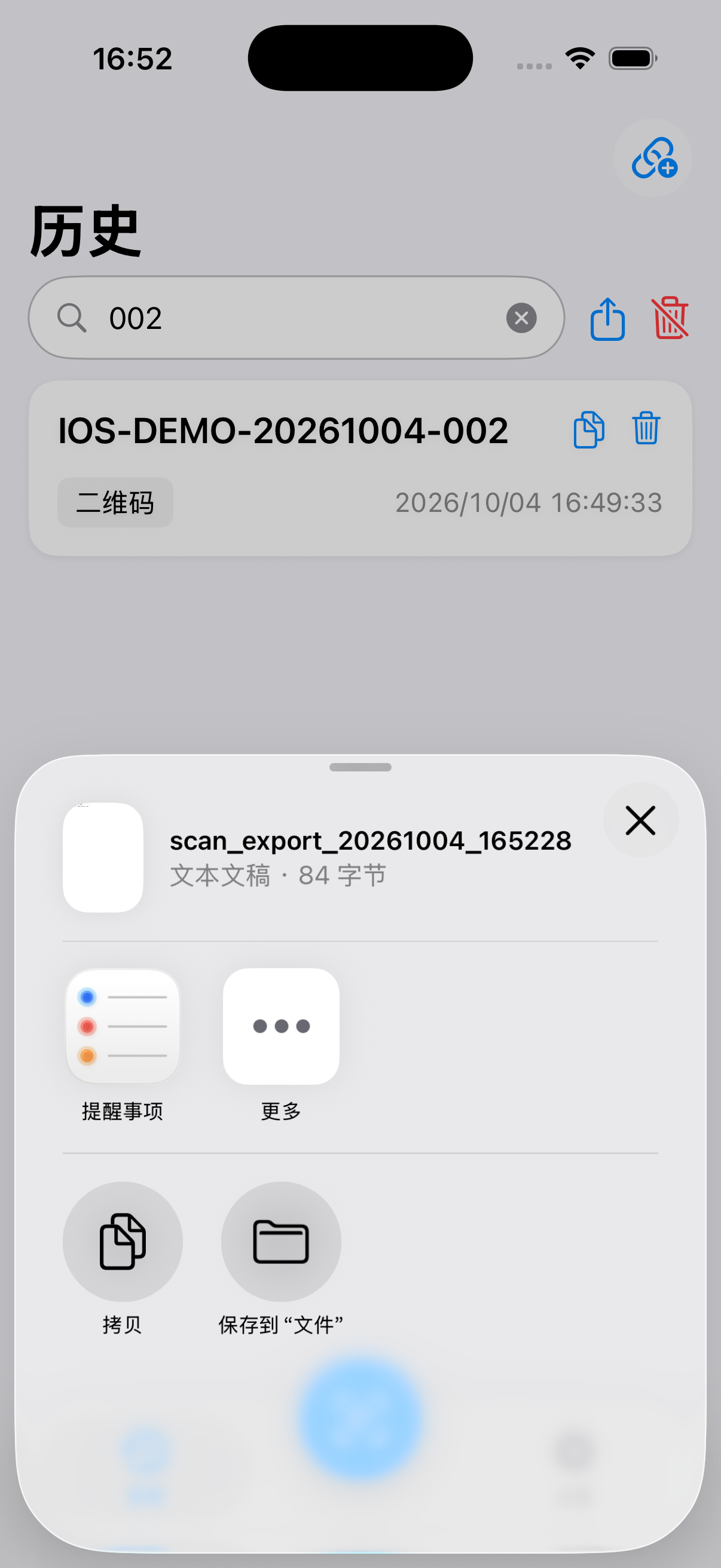
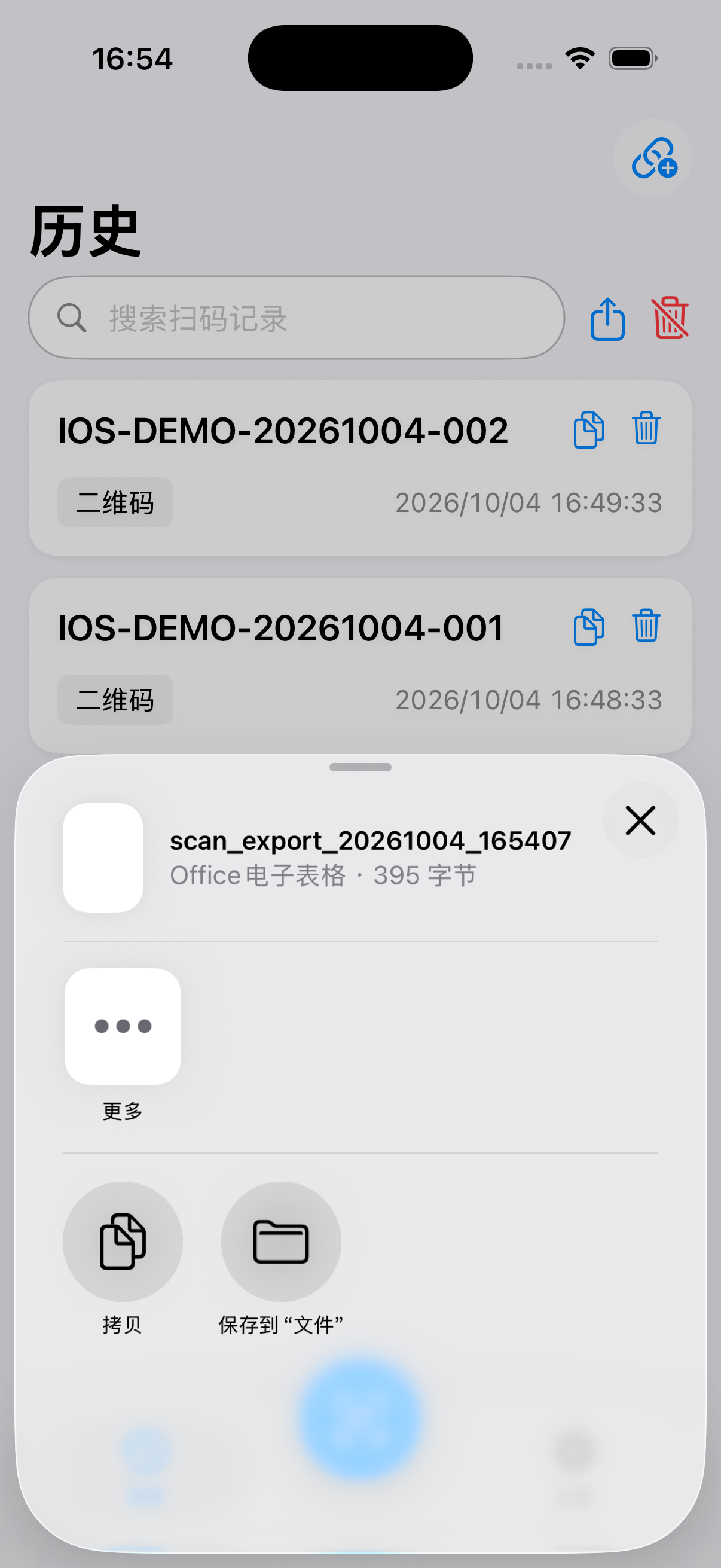
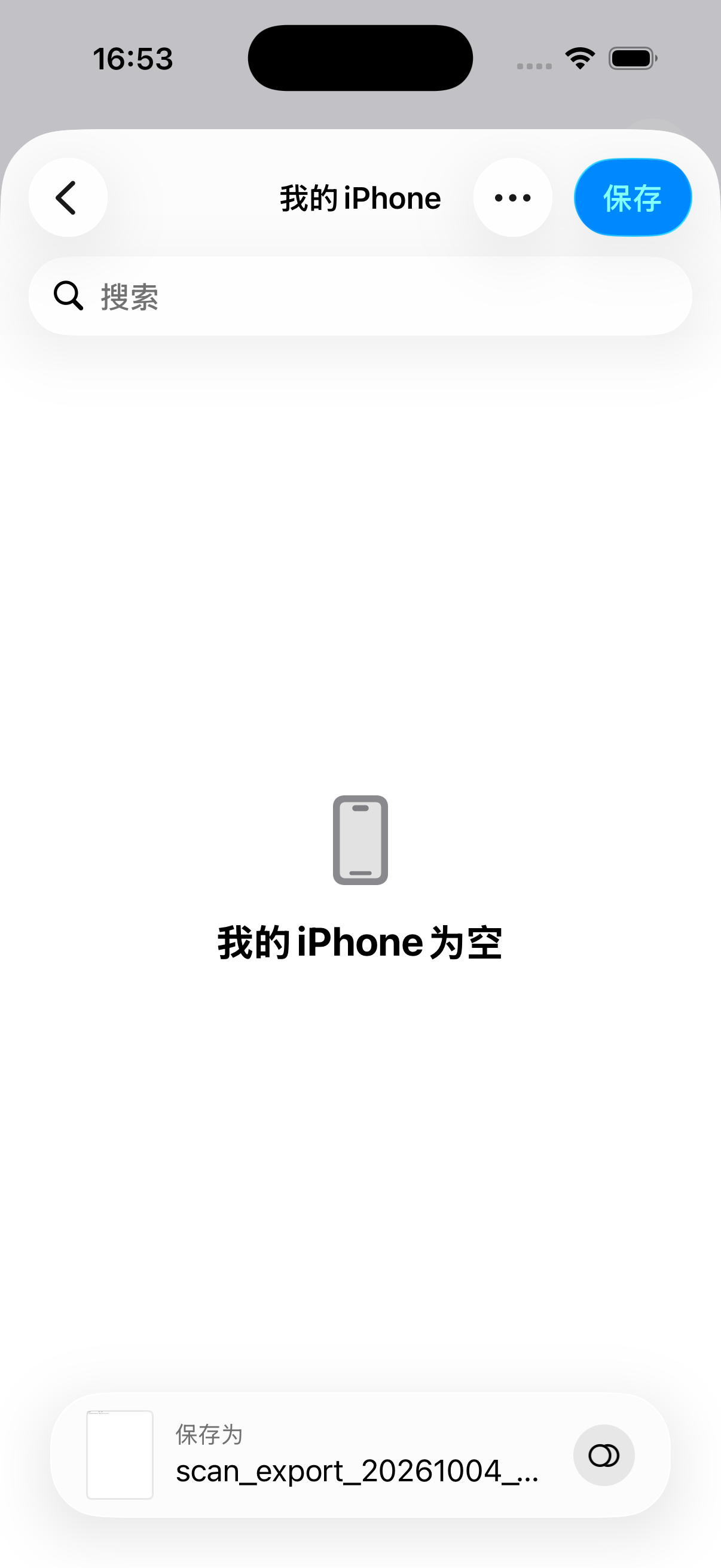
要留在自己的文件中,在 iOS 分享表选择“保存到‘文件’”(部分系统称“存储到文件”,找不到时向下滚动),选择“我的 iPhone/iPad”或你准备使用的文件位置,必要时选文件夹;核对文件名和扩展名后点“存储/保存”。默认文件名为 scan_export_日期_时间.csv 或 .xls。想改名时保留扩展名。选择其他分享目标则按系统提示完成;取消分享不会删除历史,也不代表文件已保存。To keep a file, choose Save to Files in the iOS share sheet, scrolling down if necessary. Select On My iPhone/iPad or your chosen file location and folder, check the name/extension and tap Save. Default names are scan_export_date_time.csv or .xls. Keep the extension when renaming. For another share destination, complete its system prompts. Cancelling sharing preserves history and does not confirm a saved file.
打开文件,核对四列与所选范围的记录数Open the saved file and verify columns and the chosen scope’s count
打开“文件”App,在刚才的位置找到导出文件,或在电脑表格软件打开。核对“序号、内容、格式、时间”四列、所选导出范围的记录数、中文与长编号;最新记录在前,内容保留原文,不附发送后缀。CSV 导入时把编号列设为文本,保留前导零并避免科学计数法。Find the export in Files at the chosen location, or open it in a desktop spreadsheet app. Check No., Content, Format and Time, the chosen scope’s row count, Unicode and long identifiers. Newest records appear first; content has no sending suffix. Import identifier columns as text in CSV to preserve leading zeros and avoid scientific notation.
当前 .xls 是可供 Excel 读取的 HTML 表格,不是 .xlsx 工作簿;软件可能提示格式与扩展名不一致。核对是自己的导出后按软件提示打开,或改用 CSV。CSV 使用 UTF-8 编码并带 BOM。App 打开的是系统分享流程,没有“导出成功即文件已落盘”的保证;最终以所选位置实际存在文件且能打开为准。The current .xls is an HTML table readable by Excel, not an .xlsx workbook, so a spreadsheet app may warn that the format and extension differ. Verify it is your export and follow the prompt, or use CSV. CSV uses UTF-8 with a BOM. The app hands the file to system sharing; verify a file exists and opens at your selected destination to confirm persistence.
按现象排错并完成验收Troubleshoot by symptom and complete a check
真机没有相机画面,模拟器显示权限提示No real-device preview, or a simulator permission message
真机检查相机权限,点“授权相机权限”到系统设置允许,然后回 App 退出并重进扫码。模拟器没有可用摄像头时同样显示该提示,不能靠授权恢复真实拍摄;本页模拟器的照片识别也返回运行环境错误,真机验证见相册章节。On a real device, enable Camera through Allow camera access in system Settings, then close and reopen scanning. A simulator without a camera shows the same fallback and cannot recover live capture through permission. This simulator also returns a photo-recognition runtime error; use a real device for the checks in the photo chapter.
找不到蓝牙连接或系统已配对但无法输入No Bluetooth entry, or pairing does not produce input
当前 iOS 不提供蓝牙 HID。安装电脑端,按 Wi-Fi 流程连接;不要套用 Android/鸿蒙的配对与修复按钮。The current iOS app has no Bluetooth HID. Install the desktop app and use Wi-Fi; Android/HarmonyOS pairing and repair controls do not apply.
Wi-Fi 一直未连接或提示失败Wi-Fi remains disconnected or fails
允许本地网络访问;核对电脑服务、IP、端口、防火墙与局域网互通。电脑换网络后地址可能变化。扫码连接二维码后仍需在确认弹窗点“连接”。Allow Local Network, check the desktop service, address/port, firewall and reachability. A network change may change the desktop address. A scanned connection QR still requires Connect in its confirmation prompt.
电脑收到记录,目标框没有文字The desktop receives records but the target stays empty
点目标框放置光标,检查 macOS 辅助功能、Windows 目标权限或 Linux 输入工具。先用普通编辑器验收,再用于正式表格;必要时检查后缀设置。Focus the target field and check macOS Accessibility, Windows target privileges or Linux typing tools. Verify in a plain editor before using a production sheet, and check the suffix.
相册多码只处理一条,或模拟器没有识别框A multi-code photo processes one code, or has no simulator boxes
iOS 需从最多 8 个候选中点选一条,不批量处理全部。当前无相机模拟器会遮住识别框,且本页环境照片识别失败;请在真机完成识别与点选。iOS requires one selection from up to eight candidates and does not process all results. The current camera-unavailable simulator state hides the boxes, and photo recognition failed in this environment. Complete recognition and selection on a real device.
同一码重复进入历史或电脑The same code repeats in history or on the computer
扫完把码移出画面。同码短时抑制不防止长期停留后的再次识别;检查目标已有内容后再重试,避免重复提交。Move each code out of view after scanning. Short suppression does not prevent later repeats of a stationary code. Check existing target text before retrying.
导出文件少于全部历史The export has fewer rows than the full history
检查本次或记住的导出范围。搜索时可选择“全部记录”或“搜索结果”;要恢复确认对话框,在“设置 → 搜索时导出范围”选择“每次询问”。清空全部仍删除所有历史,不因搜索或导出范围缩小。Check the chosen or remembered export scope. During a search, choose All records or Search results; restore the dialog through Settings → Export scope while searching → Ask every time. Clear all still deletes every record, regardless of search or export scope.
分享表关闭后找不到导出文件The file is missing after closing the share sheet
仅打开或取消分享不算保存;重新导出,选“保存到文件”,明确选位置并完成保存,再在“文件”App 核对。需要时换可写入位置,或选 CSV 重试。Opening or cancelling sharing is not a completed save. Export again, choose Save to Files, select a destination and complete Save, then verify in Files. Retry a writable location or CSV if needed.
手动断开后又连上,或回前台没有恢复It reconnects after manual disconnect, or fails to restore
自恢复开启时启动/回前台会尝试上次 Wi-Fi;不想恢复就关闭。未恢复时确认电脑与保存地址有效,再点连接状态图标手动连接。后台与锁屏不能作为持续录入保证。When restore is enabled, launch/foreground return attempts the saved Wi-Fi target. Disable it if undesired. If restoration fails, check the computer/address and tap the connection status icon to connect manually. Do not assume continuous entry while backgrounded or locked.
开启声音却听不到,或网页突然打开Sound is enabled but silent, or webpages open
真机检查 App 声音/震动开关和系统音量、静音状态;硬件需支持震动。模拟器不播放本 App 扫码声音或震动。网址打开时关闭“网页自动跳转”可避免连续扫码中断。On a real device, check app sound/vibration, system volume and silent mode; vibration requires supporting hardware. The simulator does not play this app’s scan sound/vibration. Turn off automatic web opening if URLs interrupt scanning.
真机允许相机 → 设置后缀 → 本地识别或连接 Wi-Fi → 电脑光标放入目标框 → 扫一条已知码并核对原文和输入 → 手机历史搜索、复制 → 明确筛选范围后导出 → 在系统分享表完成保存 → 打开文件核对四列和记录数。本页已用演示记录完成真实 UI 搜索、打开并取消单条删除与清空确认、选择格式,以及筛选后 CSV 保存到“我的 iPhone”;文件已核对 UTF-8 BOM、四列及单条 002 记录。Excel 已生成两条演示记录的文件并打开分享表,最终保存仍应按所选位置核对。照片选择器已实测,识别没有验证成功。相机与相册识别、多码点选、声音震动和实际电脑输入请在真机与对应电脑继续核对。On a real device: allow Camera → choose a suffix → scan locally or connect Wi-Fi → focus the computer field → recognize known text and check its original/target values → search/copy History → choose the export scope → complete system saving → open the file and verify four columns and count. Using demo records, this simulator verified UI search, opening and cancelling single-delete/clear confirmations, format selection and saving the filtered CSV to On My iPhone. The file was checked for UTF-8 BOM, four columns and one 002 record. Excel created a file with two demo records and opened sharing; verify final saving at the chosen destination. Photo selection was checked, but successful recognition was not verified. Complete camera/photo recognition, multi-code selection, feedback and actual desktop typing checks on a real mobile device and the relevant computer.
仍有问题可访问技术支持,提供 iPhone/iPad 型号、iOS 与 App 版本、电脑系统、连接方式、是否模拟器,以及具体提示和出现步骤。Visit Support with the iPhone/iPad model, iOS/app versions, desktop OS, connection mode, whether a simulator is involved, and the exact message and steps.